

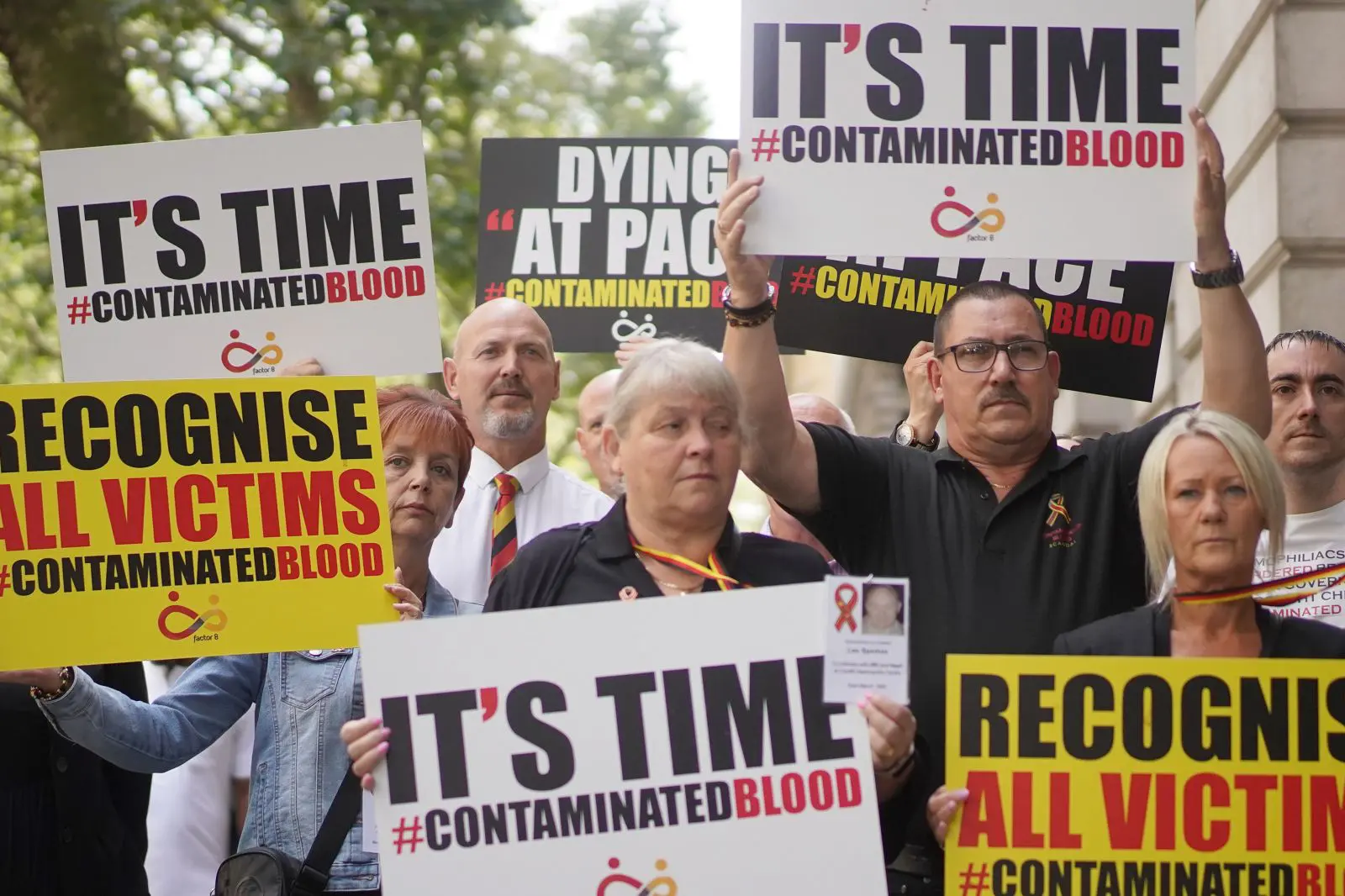
Victims of infected blood scandal to receive compensation payments for life
More than 30,000 NHS patients were treated with blood infected by HIV and hepatitis between 1970 and 1991 as a result of the scandal
Victims of the contaminated blood scandal, which is widely seen as the biggest treatment disaster in NHS history, are set to receive up to £2.7 million each with up to £15,000 extra for those subjected to ‘unethical’ research.
Claims for those who have already died – of which there are more than 3,000 – because of the scandal can be made through their estate.
Payouts under the multimillion-pound compensation plan will start by the end of the year for survivors, and by next year for affected family members under a second set of regulations.
Compensation scheme payments – including for bereaved partners – will continue for life as part of the plan, the Government said, as it announced on Friday it had accepted the ‘majority’ of recommendations from an independent review.
It has said this will ‘amount to one of the UK Government’s largest compensation schemes in recent history.’
Financial compensation payments to be given for life
The Government announced updates to the compensation scheme on Friday, which included confirmation that victims will be given support payments for life as well as additional awards to those used for unethical research.
It comes after senior barrister and interim chairman of the compensation authority Sir Robert Francis KC made 74 proposals for the rollout of the scheme, of which the Government accepted the vast majority.
Some five recommendations will not be implemented, including a suggestion to uprate support payments beyond Consumer Price Index (CPI) inflation.
Charities and campaigners have cautiously welcomed the Government’s response, though some have expressed disappointment at the scope of the measures.
Rachel Halford, CEO of the Hepatitis C Trust, said: ‘We’re pleased that the Government has listened to the concerns of the infected blood community regarding the continuation of support payments for life, which had been a significant source of anxiety for many of our helpline callers.
‘We are disappointed, however, that the existing support schemes have not been opened more widely, including to people given hepatitis C after 1991 and those given hepatitis B.’
She said the Government must work ‘transparently’ with the infected blood community to explain ‘the basis for these figures’ because ‘thousands of lives were forever altered when people were given hepatitis C and compensation must reflect that reality.’
Jason Evans, who set up the Factor 8 campaign group after losing his father to the scandal aged four, said: ‘Compensation for those impacted by the infected blood scandal has taken far too long and too many have died waiting.
‘Today, the picture of what compensation might look like has become clearer, and now it must be delivered.’
Leigh Day, which represents more than 300 people affected by the infected blood scandal, said they ‘cautiously’ welcomed the announcement but criticised the failure to refer to ‘the continued disparity in the proposals for funds awarded to those infected with mono-HIV versus mono-HCV infection.’
‘The largest cohort within the infected blood community are those infected with HCV and our clients are disappointed that it appears that this long-fought against discrimination will continue,’ they said.
Payouts for victims of unethical research ‘derisory and insulting’
Victims who were used for research without their knowledge will be eligible for an extra £10,000, with a higher award of £15,000 for those who underwent treatment as children in a notorious case at Lord Mayor’s Treloar’s College.
Children infected at Lord Mayor’s Treloar’s College were undergoing treatment for haemophilia while being experimented on without their knowledge by NHS clinicians who knew the dangers it posed, a higher award of £15,000 has been offered.
The £15,000 payout for these former pupils who were infected with HIV and other viruses while subjected to unethical medical testing is ‘derisory and insulting,’ a victim has said.
Richard Warwick described the figure as a ‘kick in the teeth’ and, along with other survivors of the trials, is considering taking legal advice on whether to seek a review.
Mr Warwick said he did not know ‘where they’ve plucked the figure from’ and that it failed to reflect the gravity of a case that was ‘perhaps a breach of the Nuremberg (code)’.
‘We all think it is derisory and insulting,’ he told the PA news agency. ‘It is unbelievable and unfathomable where they got this figure from. It’s a kick in the teeth.’
A yearly instalment for cases where victims were subjected to unethical research would have been closer to what they had been expecting, Mr Warwick said.
Paymaster General and minister for the Cabinet Office Nick Thomas-Symonds said: ‘This is an important milestone for victims and campaigners who have waited far too long for justice.
‘The Government has listened to the recommendations from Sir Robert Francis KC, heard the strong calls for change from the community and acted.
‘We are going to do everything possible to deliver compensation quickly, and in many cases deliver life-changing sums to people infected and affected by this scandal.
‘We know no amount of compensation can fully address the damage to people who suffered as a result of this scandal. This is why alongside the compensation, we must drive forward the wider cultural changes to make sure nothing like this ever happens again.’
Asked directly about Mr Warwick’s criticism, Mr Thomas-Symonds told Sky News: ‘I’ve heard Richard Warwick speak very, very movingly about his experience at Treloar’s.’
‘There was a particularly egregious breach of trust in respect of that school.’
The Cabinet Office minister said ‘no amount of money can make up for the suffering’ but that the Government had settled on the £15,000 sum for Treloar’s victims because it had been suggested by Sir Robert.
‘That is only one small element of the much larger amounts of money that are available under the tariff-based scheme,’ he said.
Meanwhile, Gary Webster, who left Treloar aged 18 with HIV and hepatitis after being tested on for years, said the £15,000 figure was ‘an insult’ and suggested survivors would ask for answers on how that sum was determined.
‘Overall, people are pleased the Government is moving forward with compensation, but both figures (the £10,000 and £15,000 for unethical research victims) are a bit of an insult really, and I think someone should look at them again,’ he told PA.
When will the infected blood compensation payments begin?
Infected people will start receiving payments through the new framework by the end of this year, while for others affected by the scandal, payments will begin in 2025.
Ministers are expected to introduce regulations for infected victims setting up the new scheme by August 24, followed by a second set of regulations for affected people in the coming months.
The accepted recommendations also include provisions for victims to receive independent legal advice to help them navigate the claims process.
How much will the entire scheme cost?
The Government has not put a figure on how much the scheme might cost overall, though awards for those at the top end are likely to exceed £2.5 million.
Paymaster general Nick Thomas-Symonds said a total estimate would be laid out in the Budget red book as work was still ongoing and more people may still come forward to make a claim.
Some 3,000 people across the UK are estimated to have registered interest with the compensation scheme.
So far, about £400 million has been paid out through interim payments of £100,000 to infected people or bereaved partners.
Related claims
-
Apple Pay
Apple sued over Apple Pay practices that allegedly pushed up banking charges for 50 million consumers.
-
Apple Pay Claim Team
Apple faces collective legal action over unfair charges borne by UK consumers using Apple Pay. This action is led by a consumer rights campaigner and one of the UK’s top group litigation law firms.
-
Apple Pay Claim FAQs
Find answers to common questions about the Apple Pay consumer claim, including eligibility, opt-out rights, funding, costs, and how collective actions work.