
Car finance: the incentives dealers don’t want to tell you about
Secret commission tactics between lenders and dealers are a cause for concern for car buyers
The financial regulator banned the use of discretionary commission on car finance loans in January 2021, after estimating around 924,000 customers could be paying £500 million in additional interest costs every year.
Car finance customers could be owed around £1,100, based on a four-year £10,000 motor finance loan that used a discretionary commission arrangement. The regulator said this month that car finance lenders could be forced to contact customers who have been mis-sold car loans to ‘offer appropriate compensation.’
But this is only part of the story. Car finance lenders have been paying car dealers other forms of commissions that may continue to result in consumers paying more for their car loans.
Court documents seen by Consumer Voice show that commission payment practices from lenders – including Lloyds Banking Group – could be encouraging car sales staff to funnel contracts to those specific loan providers, without considering the expense to the customer.
Lloyds has set aside £1.2 billion in funds to cover potential compensation payouts over car finance mis-selling.
The vast majority of car finance customers are unaware that their dealer could be receiving commission that could impact what they pay. More than nine in 10 car finance customers expressed some level of concern about car dealers receiving commission that impacts the amount they will pay – 45% were very or extremely concerned about this.
Many consumers expressed concern over the different types of commission tactics being used by lenders to secure business. And, as our undercover investigation of 25 of the biggest dealerships shows, it’s still impossible to find out the details of these commission arrangements when looking at your car finance options.
Alex Neill, co-founder of Consumer Voice, said:
‘Consumers are rightly angered by millions being paid in advance commissions and other sneaky practices that led to unsuspecting car owners being overcharged.
‘Car finance customers have also told us that they want firms held to account and would be likely to claim compensation if they were told they were eligible.’
Next week, the Supreme Court will begin the process of deciding whether the use of all undisclosed ‘secret’ commissions – not just discretionary commissions – are unlawful.
How concerned are you about a car dealer receiving commission that impacts the fee you pay back to your lender?

The secret incentives used by lenders to secure deals
More than six in ten car finance customers trust their dealer to offer them the best deal. Yet the vast majority of people we have spoken to are unaware of whether their dealer could be receiving commission – only 21% of people in our latest survey said they were aware of this.
Car finance customers have said they want to be confident that their dealer doesn’t have any conflicts of interest. Yet, even following the regulator’s ban on discretionary commission arrangements, other advanced commission tactics are being used by lenders to help them seal the deal.
An industry insider told Consumer Voice: ‘Completely unbeknownst to the customer there were agreements already in place between the car dealership and a particular lender, which had one or more incentives in it to entice the car dealership to offer the customer a finance agreement with that particular lender.’
The different types of incentives that have been revealed to Consumer Voice include:
| Incentives used by lenders | What this is |
| Advanced commission | A lender pays a car dealer a fee in advance to encourage dealers to offer their finance loans to car buyers. |
| Discretionary commission | Lenders agreed to pay dealers a higher commission if they arrange for a buyer to pay a higher rate of interest on their loan. Banned since 2021. |
| Right of first refusal | A car dealer explicitly agreed with a lender that their finance deal will be the first they offer a buyer. |
| Stocking facilities | A lender gives dealers the funds to buy cars for their forecourts in return for their finance deal to be offered to people buying these cars. |
| Volume bonus | A lender agrees to pay commission and a bonus to a dealer if it puts an agreed volume of business its way. |
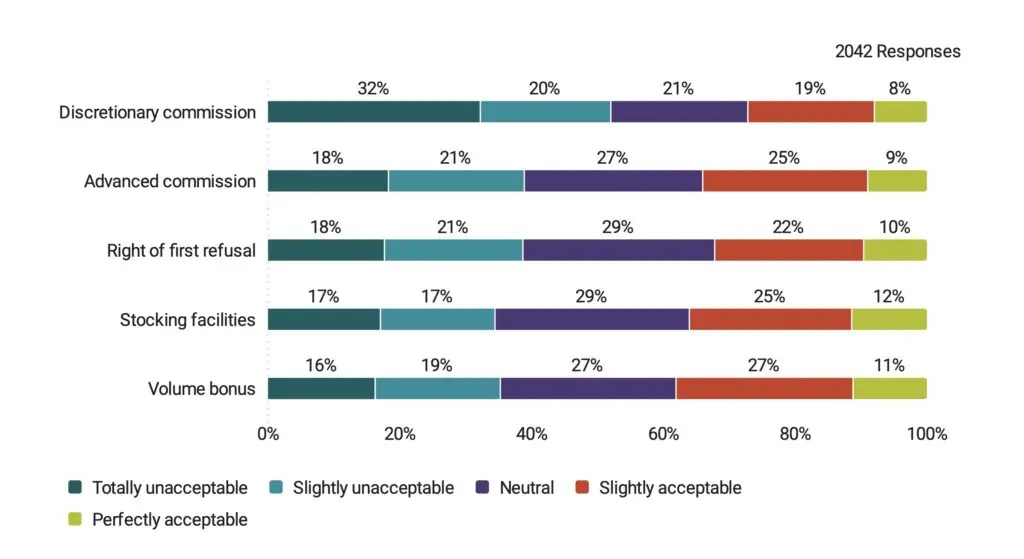
We explained these different types of incentives to car finance customers and asked them what they thought about them. Only around one in ten found them completely acceptable. There was most cause for concern for discretionary commission arrangements – with 52% of people saying they were unacceptable.
Around four in ten people (39%) found advance commission and right of first refusal unacceptable. And around three in ten found stocking facilities and volume bonus incentives unacceptable.
We saw high levels of neutral responses, which could indicate no strong opinion either way but we think it’s more likely that it reflects the complexity in understanding these different arrangements.
Tell us whether you find the following types of commission arrangements acceptable business practices from your perspective as a car buyer:
Car dealers need to be more transparent about lender commissions
It wouldn’t be unreasonable to think that the spotlight on car finance mis-selling had led to dealers being much more open about the commission arrangements they have in place with lenders, and the details of lenders they’re working with.
Wrong. Well, partially wrong.
Less than one in 20 (4%) people shop around for car finance deals. It’s something we’ve recommended people do to help them get the best deal possible. So we put this to the test to see how easy it was to find out about commissions paid to lenders.
We posed as a car buyer, with a monthly budget of £300 to £400, to investigate whether car dealerships declare the commission they receive, and the lenders they work with, when comparing deals offered online.
Good news first. Only one of the 25 major car dealership websites we looked at didn’t declare commissions.
But, this information was typically part of the small print, often located at the bottom of the vehicle page – found under headings such as ‘Financial Disclosure’, ‘Commission Disclosure’, or ‘Terms and Conditions’ – and at times requiring you to click through to another page for the information.
And, although all dealers gave illustrative examples of how a car finance loan breaks down, none gave an illustration of the level of commissions received. Often using generic statements like: ‘We can introduce you to a limited number of lenders and their finance products which will have different interest rates and charges.’
And: ‘Whichever lender we introduce you to, we will typically receive commission from them, either a fixed fee or a fixed percentage of the amount you borrow.’
Information about the types for commission arrangements in place was lacking. We saw broad statements like: ‘Different lenders may pay different commissions for such introductions.’ Although two dealerships did give some detail around this: ‘Some lenders may also provide preferential rates to us for the funding of our vehicle stock and also provide financial support for our training and marketing.’
It was impossible to work out what impact these commission arrangements will have on the price you pay. While some said: ‘The amount of commission we receive does not affect the amount that you pay under your credit agreement.’
Others stated things like: ‘This commission is payable to us by the lender (not you) but part of the interest charged to you under your credit agreement with the lender will pay them for their costs, including the commission they pay to us.’
Some did stipulate the details of the commission they will receive from the lender will be provided ‘before you enter into the agreement’ or ‘prior to the lender introduction.’
We were surprised to see some lenders still stressing: ‘The interest rate is fixed by the lender therefore neither the interest rate nor the agreement length has an influence on the fee that we are paid.’ The practice of your interest rate being linked to the commission payment – known as discretionary commission – was banned in 2021.
‘Limited’ information about the lenders
Information about the lenders that dealerships have relationships with was limited. With 20 of the 25 websites vaguely stating they will introduce customers to a ‘limited number’ or ‘selected panel’ of lenders.
Five of the dealerships we looked at did provide more useful information on this. With three of these being completely transparent about the list of lenders they work with. The number of lenders varied considerably with one dealership declaring they work with a panel of 29 lenders and, at the least, one said they work with only three lenders.
Car finance compensation: Act now!
Don’t be left in the dark if you suspect you were not informed about the commission fee – and, as a result, may have not got the best deal possible on your car finance.
Contact your dealer or lender to check if your deal involves a commission arrangement. Acting now could help you understand more about what you could be owed when the regulator makes a decision about compensation.
Use our free template letter to help you make your complaint to your lender or read our guide for more advice.
Compensation claim letter
Download our free letter template for claiming back compensation for mis-sold car finance.
Register now for our free letter template to help you with your car finance complaint.
Consumer Voice research
We conducted an online survey of 2,042 UK adults who had taken out car finance loans arranged by their car dealership.
People responding to the survey had taken loans between 1 April 2014 and 28 January 2021, which is when the ban on discretionary commission arrangements came into force. The survey was conducted between 14 and 22 February 2025.
We reviewed the top 25 car dealership websites posing as a customer looking to buy a new car with a budget of £300 to £400 a month. The top dealerships were identified based on various metrics, including revenue, sales volume, and dealer satisfaction.
We reviewed the vehicle pages of five different makes and models of cars on offer at each dealership. We were looking for what information dealers provide about commissions and fees on their websites, how this impacts payments and what information is provided about the panel of lenders it works with.
Consumer Voice is free use, independent and we tell consumers when the companies they buy from have broken the law. We help people easily work out whether they’re entitled to compensation and how to claim.
Sign up to our newsletter to stay updated on claims that could leave you owed compensation.
Related claims
-
Apple Pay
Apple sued over Apple Pay practices that allegedly pushed up banking charges for 50 million consumers.
-
Apple Pay Claim Team
Apple faces collective legal action over unfair charges borne by UK consumers using Apple Pay. This action is led by a consumer rights campaigner and one of the UK’s top group litigation law firms.
-
Apple Pay Claim FAQs
Find answers to common questions about the Apple Pay consumer claim, including eligibility, opt-out rights, funding, costs, and how collective actions work.